GLEE & The Cultural Facade of America

GLEE_1

FOX 6 Tuesday 3/30/2011 (7-9pm)

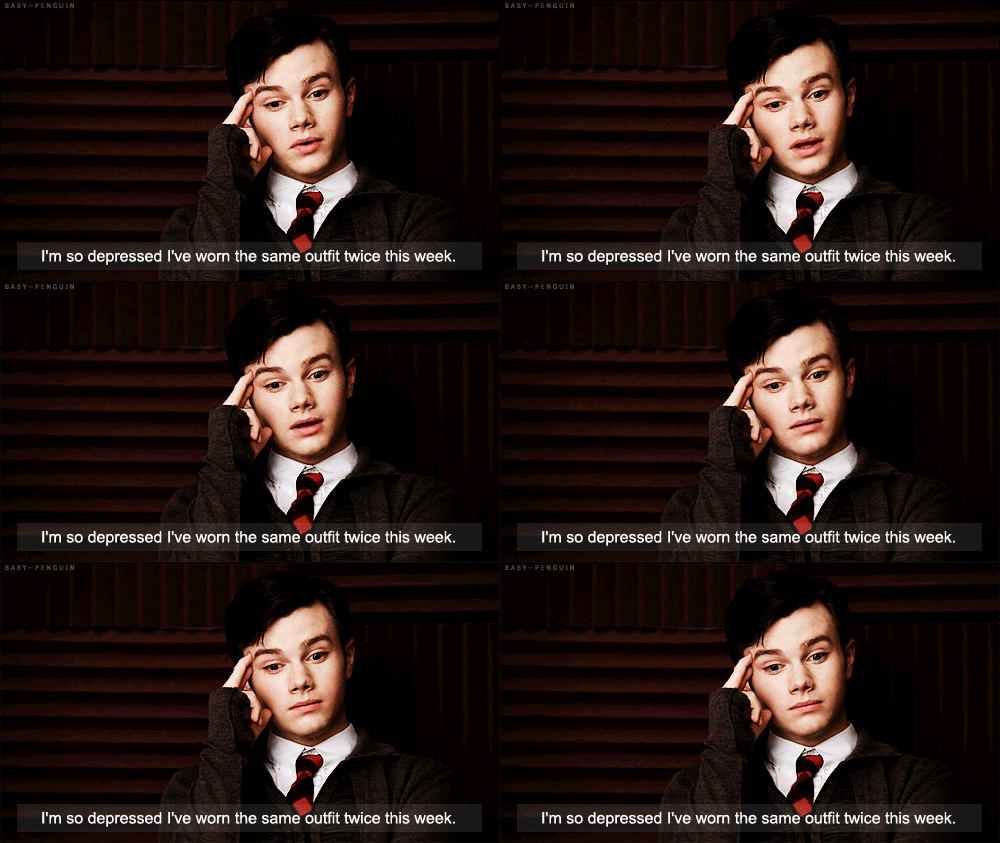
             At first glance FOX 6 has a Tuesday night line-up that comes off as endearing and comical- and not to mention entertaining. Their primetime lineup kicks off with Glee (a show responsible for more Billboard Hot 100 songs than Elvis), picks up with the quirky but palatable Raising Hope, and concludes with a dramedy entitled Traffic Light. A segment of television akin to this one will always prove to be easily digestible, but a close analysis reveals the aims and goals set forth by dominant society. Through the casting, advertisements, and discourse of each program a viewer can decipher the racial hierarchy and ideals of an American patriarchal society.

Jeremy Butler states that, “A segment of televisual flow… may be though of as a televisual text- offering a multiplicity of meanings or polysemy.” This portion of broadcasting is no exception. The programs and commercials are both instilled with contradicting ideals polysemic approaches- a tactic employed by a commercial industry in an attempt to appease and appeal to the broadest possible audience base. Glee’s diegesis demonstrates an understated yet clearly defined dichotomy between teamwork and individuality, as well as heterosexual vs. homosexual relationships. High school glee club “New Directions” is preparing for show choir sectionals when club director and Spanish teacher Will Schuester (Matthew Morrison) decides to give the lead vocal parts to Quinn and Sam while Finn and Rachel are (The normal leads and co-captains) left supporting roles. From the moment this conflict is established it becomes evident that teamwork, and the advocating thereof, will become a dominant theme throughout the episode. As a result of Rachel’s selfishness and anger the choir becomes less tolerant of her as group unity seems to concurrently disintegrate. Their unifying moment comes during a performance at sectionals where they have been inspired to perform by Schuester’s pre-show “teamwork” speech. Just a few scenes prior to this moment there was a segment between Rachel and Kurt in which individuality is championed with her telling him that, “singing is personal. It’s about you.” From one end of the spectrum Glee comes across as a fairly liberal show with the incorporation of a gay male protagonist in a lead role. Alternative viewing and closer inspection reveals a relegation of Kurt’s character and subsequently a quiet repudiation of his sexual preference. Kurt’s efforts to be recognized as an individual- his suggested use of Duran Duran’s Rio and audition for sectionals- are continually denied. After his solo audition a character remarks, “it’s about being part of a team… you’ll fit in soon enough,” a utilization of dialogue that engenders a dominant Christian view of gays as an “inferior breed.” The fact that there is clear sexual tension between Kurt and another male character (expressed predominantly through character gaze) but it remains ignored while every possible heterosexual coupling is being explored helps to solidify this claim. So while homosexual characters may take on a lead role they are still function on a comparatively dismissive level.

Commercial “interruptions” are also littered with a “multiplicity of meaning.” What Butler’s quote does not bring to light however, is the prevalence of certain ideals. Throughout the two-hour segment there was a singular commercial that promoted the use of public transit. Apparently in the interest of the environment and consumer bank accounts the advert promoted city bus lines as an alternative and superlative means of transportation. Though it may be a valiant effort and a worthwhile cause the message is lost amongst auto industry giants and high production value spots. Every commercial break contains at least one add (and in most cases multiple) for new automobiles: Toyota, Ford, Jeep, Chrysler, Volkswagen, and the list goes on. The purchase, or promise of purchase, easily becomes the cardinal objective and it becomes clear that the main purpose of not only advertisements, but also the programs themselves, is the gaining of capital. Another example that remains consistent with the polysemic nature of the televisual text is the alteration between unhealthy fast food plugs and images of strikingly beautiful, slim individuals. Programming almost always includes a juxtaposition of themes and ideals to appeal to more diverse group of viewers but proclivity towards certain types of advertising remain ever-present.

Main targets of these time slots are most obviously working class Caucasians. The majority of integral relationships and characters of all three shows were occupied almost exclusively by good looking white’s while less significant parts were given to over-assimilated and often stereotyped blacks and Asians. Each show centers itself around difficult but loving relationships between a white male and female, which induces a fantasized notion of the familial nucleus and conventional Christian marriage ideals- something perpetuated by race representation and hierarchy within the advertising sphere. Taking note of diversity in these advertisements reveals quite an astounding lack of any minority group, while extremely beautiful or familial figures retain the spotlight. An overwhelming number of these commercials so blatantly dismissive of ethnic/ racial diversity seems to contradict the principal of cross-platform marketing alluded to earlier, but rather it is most likely an attempt to further cultural assimilation; it is the dominant white society’s subterfuge via free televisual entertainment.

With few exceptions this two-hour segment of television reveals itself to be one giant advertisement for the classic “American dream,” an illusory aspiration that has to be one of the biggest and most successful cultural facades to date. We are asked to find a significant other, get a home, buy a car, pay for insurance, eat out, and spend money on whatever new phone or fashion is on the market, but who is persuading us to do this? Who is the on-screen surrogate for the couch spectator? At least in this instance it appears to be patriarchal white society, spoon-feeding the public morals and ideals that are nothing but self-serving and monetarily motivated.
“The Coded and the Clothes:” Transitioning dualities in a scene from L’Avventura

lavventura


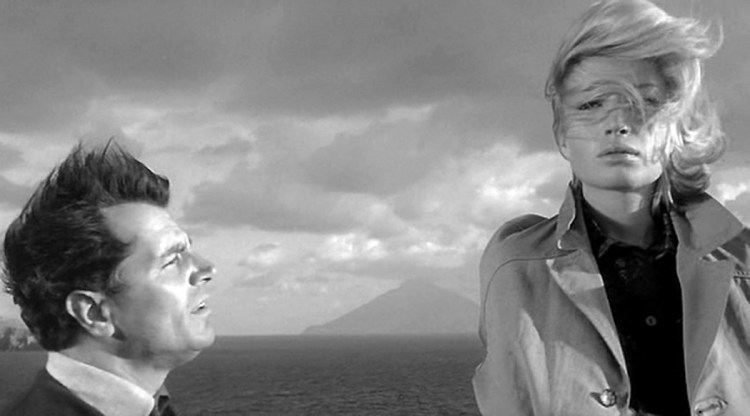
Dual personalities and alter egos are devices used relatively often within the cinematic realm. With L’Avventura (1960) Michelangelo Antonioni constructs an existentialist world predicated on the metaphorical transitioning from one character to another, doing so in a subversive manner the dualities and the “replacement” of a central figure thrive under a narrative guise. Anna and Claudia changing beneath the boat deck is the last major transition between two distinctly different types of women. With precise construction Antonioni creates a short scene that, with the aid of relatively minute dialogue, visually signifies a shift toward marital status in lieu of independence and genuine happiness.

Essentially, Anna and Claudia function in the early stages of the film as two pieces of a whole. Anna’s persona and character is metaphorically equivocal to female independence, intuition, and cunning while Claudia comes to signify the ignorant bride given in to the pressures of societal norms and expectations. Claudia is symbolic of what Anna has become upon reluctantly agreeing to marry Sandro, a man with a dangerous libido whom she does not love in even the most minuscule way. Through assumed pressuring from her father, Sandro, and social conventions Anna agrees to the engagement though clearly removed from her fiancée physically and emotionally (as emphasized by their initial sexual encounter). After Anna feigns the sighting of a shark Sandro escorts her and Claudia to the lower deck of the boat in a scene that signifies the final transition of personalities. The first thing to take note of is the blocking and framing of the first shot from below deck. As all three characters enter the room Claudia occupies the right side of the frame with her back to the camera and respectively her face towards Sandro, Anna however takes up the left side of the frame and keeps her back to Sandro the entire time he is looking at her. Sandro initially positions himself behind Anna but is quickly told off by her while she refuses to reciprocate his gaze and attention. Her spoken words further resonate with the concept of shifting identities as Anna coldly remarks to Sandro, “I’d like to change now.” She watches through the crack of the door with great intent until Sandro has left the vicinity. Her gaze and overall demeanor evoke an impression of scheming and unsettling omnipotence in relation to Sandro but more specifically Claudia. When Anna knows Sandro has left she immediately tosses the towel towards the ground, slightly in the direction of Claudia, before completely closing the door he had left open. Just prior to his departure Sandro had attempted to drape Anna in an all-white towel, a cleverly instituted symbol of matrimonial purity. The real significance of the towel rests, not necessarily in its tone, but rather in how it functions in relation to both Anna and Claudia at differing times in the scene. At first it is thrust upon Anna as she begrudgingly accepts it onto her shoulders, but once Sandro is gone she tosses it aside for Claudia to grab. As Claudia promptly picks up the towel she moves slightly towards the center of the frame- an indication to the spectator as to who will be the central female figure throughout the rest of the film. Prior to this shift the frame is quite literally split in half by the doorframe, the two women each occupying an opposite side.

Clothing and wardrobe are the most intricate and precise strategies used by Antonioni to convey meaning in this sequence and throughout film as well. In just under three minutes of screen-time Claudia has shifted from almost entirely black to entirely white dress, an obvious signifier of the events that are about to unfold. She begins with a swimsuit of solid black offset slightly by specs of white in her cap but once it is removed stark blonde hair is left prominently displayed in juxtaposition to Anna’s. The aforementioned towel and its symbolic presence soon cover up the remaining solid black of Claudia’s suit. Almost immediately after this Claudia undresses completely; she becomes a clean slate for Anna to mold. Her next piece of clothing is the second of three wardrobe phases within the scene. At the behest of Anna, Claudia is briefly adorned in a dress that is both black and white. When Anna begins to change we are presented with a shot harkening back to the first one of the sequence (in the way each occupies one side of the screen) but in this instance Anna occupies the right side of the frame and Claudia, when she enters, has been positioned to the left- their gradual transitioning prominently displayed through shifts in character blocking and cinematographic framing. In the last shot of the scene both women stand side-by-side with bare shoulders while they change into new, tonally appropriate outfits. Because their final wardrobe change occurs simultaneously we may more readily equate their actions to being dependent and responsive to one another, reiterating notions of duality and the split persona. Anna puts on a white and black patterned dress that leaves her back bare while Claudia’s dress is much less provocative. The distinct differences in bare skin function as visual metaphors for independence and sexuality that is to be lost with marriage, especially if it is at the hands of a womanizer the likes of Sandro. Claudia’s white garb engulfs her entire body in the shot almost suffocating her and meanwhile Anna lights a cigarette while confessing to lying about the shark sighting. All of these filmic devices function together in an effort to posit the need for independence and sexual intrigue onto Anna and transfer her promise of marriage and conformity unto Claudia.

Though there is a prominent shift of character alignment in relation to Sandro and his affections epitomized by the alteration of Anna and Claudia’s dress, Anna’s gaze and body language seem almost equally as important at times. She seems to smirk knowingly at the fate of herself and subsequently Claudia. It is as if Anna has knowingly set into motion events that lead Claudia to take the proverbial “plunge” that is marriage in place of her. Throughout the beginning portion of the scene it seems as if Anna has planned an escape of sorts but her demeanor towards the close of the segment alludes to only disappearance. If we consider the two women as opposing forces in a unified whole, it justifies the unanswered disappearance of Anna from the narrative. In this instance a character has not really vanished or gone missing but rather part of one woman has disintegrated. Upon agreeing to enter into marriage autonomy, sexual prowess, and independence is relinquished to a false sense of security and love that is ultimately shattered and left ambiguously represented with the “resolution” of the film. Initially Anna’s reactions and gaze are somewhat eerie, condescending, and almost omnipotent towards Claudia but when they are discussing the supposed shark and Sandro a noticeable shift occurs. Claudia remarks, “I don’t need to know why you behave this way. It’s Sandro, I suppose,” to which Anna seems temporarily stunned, even worried. She slowly turns her head towards Claudia careful not to make eye contact as if she is afraid that Claudia has caught on to what is about to happen. It is important to realize that this is the moment in which Anna’s dialogue abruptly ends even though she is immediately presented with a question. She is silent, transferring her voice and relational ponderings over to Claudia who exits the frame to the top deck as Anna sits down and stares in her direction. The look on her face, though only briefly held, is perhaps the only look of sorrow, pity, or compassion we witness from Anna’s character. After this moment of contemplation has passed Anna returns to her sly stare accompanied by the subtlest of smirks. She picks up the darker dress and stuffs it into a black bag as if packing for an escape from matrimonial relegation.

Through this brief scene in L’Avventura one can extrapolate great meaning in terms of thematic constructs, character relations, cinematographic practices, and filmic composition as a whole. Antonioni utilizes every aspect of the medium to convey a message about the loss of identity that accompanies marriage, especially when it isn’t precipitated or propelled by love of two individuals. He utilizes wardrobe, framing, blocking, dialogue, movement, and other devices to represent a disappearance of identity and independence that accompanies conforming to standard societal practices and expectations for no good reason other than to appease others. Anna subverts the narrative construct and asks the spectator to recognize the disappearance of an individual who will never be seen or heard from again. With The film’s final image Claudia begrudgingly caresses Sandro’s head as he sobs. Wherever Anna is she is undoubtedly better off than Claudia who has become another disposable woman in the life of Sandro. In existential purity it is the result of individual decisions that have led our characters to the point of emotional collapse.