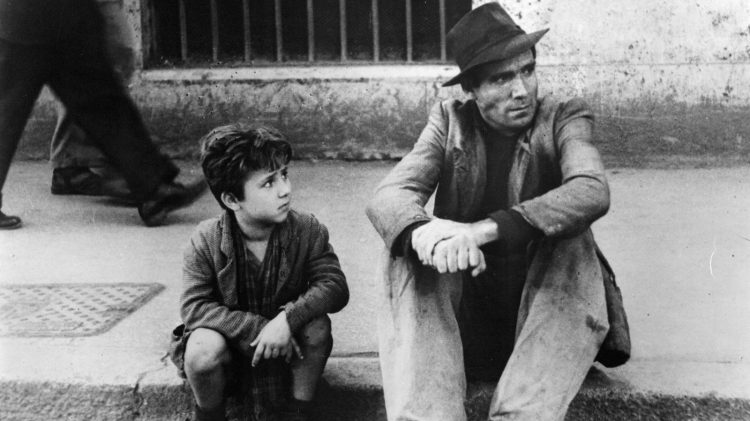
 The end of the Second World War brought about a conflicting cultural, social, and political renaissance to every civilized part of our planet. While the United States progressed towards a period of substantial economic boom other countries were left to pick up the pieces, trying to reconstruct disheveled economies and shattered spirits. Cinema, as we have come to understand it, has been and always will be an outlet for not only creative expression but progressive sociopolitical commentary as well. Italian cinema subsequent to the fall of Mussolini is no exception. Left with a “vacuum” in the industry and facing prodigious problems of reconstruction Italian filmmakers attempted to move away from every convention established by Hollywood and the “white telephone” films generated by the fascist regime. With Roberto Rosellini’s 1945 film Rome, Open City the neorealist movement began its upheaval of the purely spectacle, fantasized versions of reality that had been exhibited so prominently before, and continued until the 1952 release of Vittorio De Sica’s Umberto D (though it would be fair to argue that Fellini’s film La Strada, released two years later, is a more than sufficient example of neorealist filmmaking). However, the most abundantly pure and verifiable example of this movement, devoted obstinately to the power and effect of realism, comes to grand fruition in 1948 with De Sica’s Bicycle Thieves. While the film utilizes all conventions characteristic of the movement such as non-professional actors, location shooting, documentary style filming, everyday subject matter, and anti-fascist political ideals what sets it apart is its much deserved classification as the first example of pure cinema. Through many subtleties the narrative aesthetic becomes fixated within a realm of unsurpassed and uncompromised realism that seemingly delineates the woes of post-war Italy without any overt symbolism or grandiose filmic devices or coincidences. De Sica seamlessly constructs a world that while at its core is still spectacle, lets the viewer revel in a realm cinematic reality that becomes the closest embodiment of truth film has to offer.
Andre Bazin summarizes De Sica’s unrivaled feat in perfect words:
De Sica’s supreme achievement, which others have only approached with a carrying degree of success or failure, is to have succeeded in discovering the cinematographic dialectic capable of transcending the contradiction between the action of a “spectacle” and of an event. For this reason, Ladri di Biciclette is one of the first examples of pure cinema (1).
One thing that makes the film such a substantial benchmark in world cinema is its consistency, its perseverance to stay to true Bazin’s statement from beginning to end. Every scene throughout is meticulous in its representation of 1948 Italy and the ordinary life. Within simplicity and the mundane hibernates the beauty of what is being created. The scene in which Antonio is discussing his need for a bike with Maria is a perfect representation of neorealist filmmaking and the notion of a “pure cinema,” not only because of its void of the extraordinary but because of its consummate representation of space and time. One might argue that the cuts remove the spectator in drawing attention to the world of film, but to make any claim like that would presumably be under some sort of voyeuristic pretense. What those carefully placed edits ultimately provide to the viewer is a continuation of events rather than spectacle. They do not displace any time or space, as they are all congruent to the action that is taking place during what is a pretty substantial lull in conversation between husband and wife. As Antonio and Maria enter the door the shot cuts with perfect continuity and does not cut again until it is forced to continue the event as it progresses through the space of their apartment and into another room, never removing itself from one continuous time frame during the scene and consequently not allowing the viewer to question whether or not the events may be operating apart from one another. In discussing the importance of simplistic and “accidental” elements that cement the outright banality that is the foundation of this film it becomes imperative to examine the lack of what might be termed “sensational” shots. The lack of significance within the framing and camera movement is precisely what renders the film as pure cinema as it is taking no extra measures to step outside the realm of reality to convey a social or political meaning; it exists entirely on its own within De Sica and screenwriter Cesare Zavatinni’s carefully crafted, purposefully unremarkable cinematic territory. Bazin remarks:
If the event is sufficient unto itself without the direction having to shed any further light on it by means of camera angles, purposely chosen camera angels, it is because it has reached that stage of perfect luminosity which makes is possible for an art to unmask a nature which in the end resembles it. That is why the impression made on us by Ladri di Biciclette is unfailing that of the truth (2).
One of the most impressive qualities inherent within the film is its wry critique of post-war Italy. De Sica manages to convey a barrage of social and political messages without every really saying anything about them. Whether it be movement, mise-en-scene, action, or events every occurrence within the narrative may be attributed to mere happenstance.
Even when Italian neorealist films are not explicitly concerned with wartime and postwar issues, their male heroes demonstrate the kind of lack rampant during the occupation and post war period… the humiliation of the male protagonist rests in his precarious socioeconomic status, which invariably prevents him from fulfilling the role of economic provider and protector ascribed to men by the dominant fiction (3).
The “lack” Roberto and Wilson mention is intrinsically imbedded within every sequence of the film. In one instance of feigned hope Antonio appears to have found the man who he believes has stolen his bicycle. For a moment we are left to conjure a false hope as he pursues and eventually catches up with the supposed thief, which culminates, after a police search, with what seems to be the entire community pontificating the mans innocence. Antonio is left once again despondent in his efforts of futility. “Throughout the sequence, the film undercuts Antonio’s agency as male protagonist by subjecting him to the gaze of strangers, especially women and children (4).” The German cap worn by the accused should also be observed as a subtle aesthetic device employed to symbolize the “failed duel with German occupiers.” The army cap now becomes a pristine example of how Bicycle Thieves manages to capture the fundamental qualities of pure cinema as it can easily be attributed to coincidence; it has no overt political meaning, significance, or presence within the film and for that reason it is extremely effective within the realist milieu. Upon examination it is compulsory to observe that all of these incidents are not intertwined but rather occur independently of one another much in the way of a typical day in a person’s life. We are being omitted from obligatory propaganda and manifest symbolism as the filmic world operates on the basis of uncertainty, chance occurrence, and being set up in a narrative littered with ambivalence. Bazin remarks that, “the events are not necessarily signs of something, of a truth of which we are to be convinced, they all carry their own weight, their complete uniqueness, that ambiguity that characterizes any fact (5). “
Even when, for a brief moment, things start to look promising for Antonio and his family there is an omniscient sense within the spectator compounded with subtle detail that alludes to foreboding doom. Any chance that the Antonio and his family seem to have is visually stripped away early on as Maria goes to sell the linens in order to redeem a bike for her husband. Millicent Marcus solidifies this notion:
Any tendency to see the protagonists as exceptions to the impoverished masses is discouraged early in the film when Antonio and Maria pawn their wedding sheets in order to redeem their bicycle from hock. If we think that this difficult sacrifice will be enough to set them apart from the crowd and rescue them from destitution, we are wrong, as a dizzying tilt shot reveals when it follows the pawnshop attendant up to the top of a mountain of shelves filled with similarly pawned trousseau linens. In a later visual essay, Antonio’s story is universalized by the multitudes of used bicycles shown at the open markets on the day after the theft (6).
This constant sense of failure can be seen, and felt for that matter, in the moments leading up to the theft of the bicycle. As Antonio begins to post Rita Hayworth to the final wall there is anguish, a tension associated with his demeanor. He is much too happy and carefree in his work as he attempts to wrestle the creases out of the poster. The audience can see the bicycle situated an uneasy distance away from him as his attention is suspiciously drawn away from it for an extended period of time. Prior to this instance we also see him abandon his bicycle in the hands of young children while he follows his wife to the fortuneteller. It is a series of events escalating in such a fashion that viewer is left in perpetual suspense, resulting mostly as a result of the film’s title. This may very well be the singular flaw of the films cognitive basis pure cinema as it alerts one watching to be conscious of the fact a bike will be stolen, and though it may very well refer to Antonio’s actions during the summation of the film, any decently intelligent viewer would be able to deduce almost immediately that Antonio’s bike must be stolen at some point out of pure necessity for the events to unfold and for the film to even exist. As it stands the title is the one thing that subverts the uncanny realistic nature of the diagetic world.
The beauty of pure cinema inherent within the film is that it wholly trusts the spectator to make proper summations and ask questions with almost no information being spoon fed by the filmmaker; it makes certain to necessitate the sagacity of its viewer. Bazin remarks that, “it is our intelligence that discerns and shapes it (social thesis), not the film. De Sica wins every play on the board without ever having made a bet (7).” It is precisely this trust in the audience that lends itself to extreme realism. In pure cinema, as in real life, there are not extremely fantasized sets, wardrobes, or unbelievable events occurring all the time. Bazin reiterates commenting that, “the film shows no extraordinary events… There are no crimes of passion, none of those grandiose coincidences (8).” The simple fact that there are no professional actors (especially in a film made by such a prominent one) is a big part of why the social position established by De Sica and Zavatinni is able to envelop the spectator with utter believability. If Cary Grant had been cast in the role as had been suggested to De Sica the film would never have succeeded in originating a cinematic escape based so firmly and effectively in a believable world. This is not to undermine Cary Grant’s acting ability, but rather to state that the verisimilitude would have suffered greatly, or perhaps would not have existed at all, if it had not been for no-name, faceless actors. This device allows for the audience to have free association from the characters rather than thinking back on how good Antonio was as agent Devlin and how he looked so handsome kissing Ingrid Bergman. Instead there is the presentation of the ordinary, the everyday man that we might pass on the street and not think twice about.
It is said that, “It would be no exaggeration to say that Ladri di biciclette is the story of a walk through Rome by a father and his son (9).” Except for the exceptional plight bestowed upon Antonio a walk through Rome with Bruno is in fact all the film is but this dynamic father-son relationship stands out as a key element in the film. There have been many interpretations as to the nature and understanding of Bruno’s character. Bazin remarks, “it is the child who gives the workman’s adventure its ethical dimensions and fashions” “it is the admiration the child feels for his father and the father’s awareness of it which gives its tragic stature to the ending (10). ” This statement becomes absolutely indisputable when the film nears its conclusion and sees Bruno save what very little dignity his father is left with. Later Bazin says that Antonio has been like God to his son, and in way of contradiction, it seems like quite the opposite in many cases. The child represents the untainted pureness of the human race as a whole; he is capable of seeing the truth and acting appropriately in social situations, quite unlike his father. Bruno embodies a proper moral code that De Sica, through Bruno’s gaze, is asking us as the audience to procure ourselves. “The gaze of the child becomes a cipher for the social order to judge the actions of the male… the male is now the subject of the socially disciplining gaze (11).” As a filmmaker he is presenting us with a force not alienated nor stained by the woes of the adult society. Bruno is the one who fixes and polishes the bike, he takes on an equal role in the search (and a much more levelheaded one), he is the voice of reason when Antonio has none, and he is the one who has a job. Bruno is what Antonio might have been before being unwittingly conformed by his social confine. Marcus counteracts the argument when talking about the boy’s restoration of the bicycle calling it an “obvious projection of his desire to rehabilitate his fathers parental authority (12),” but it seems also fair to consider this a commentary about the purity of children and how, in many cases of crisis in modern society, they act much more appropriately and honestly to whatever situation they are confronted with. This scene implies that Bruno cares for the bike, his job, and the well being of his family members more than his father; it leads the spectator to believe that if it had been Bruno in charge of the bicycle nobody would ever have been able to steal it to begin with because of his watchful and attentive nature.
As we come to define the Italian neorealist movement so do we begin to completely develop Andre Bazin’s concept of “pure cinema.” Essentially what enshrines the Bicycle Thieves as the first proper example of pure cinema is that it was the undoubtedly the preeminent neorealist film. It has essentially been put to the neorealist test, and once it advanced with flying colors, was put through a cinematic purifier that washed it clean of any phantasmagorical spectacle leaving the “thesis of the film hidden behind social reality (13).” The work stands the test of time as it is magically bends and molds to different genres of narrative and documentary, creating a distinctly unique film that reinvents cinema into something that almost isn’t cinema in the least. He has managed to “escape from the impasse, to reaffirm anew the entire aesthetic of neorealism (14).”
Works Cited
- Bazin, What is Cinema? (University of California Press, 1971)
- Bazin, What is Cinema? (University of California Press, 1971)
- Ruberto & K. Wilson, Italian Neorealism and Global Cinema (Wayne State University Press, 2007), 29
- Ruberto & K. Wilson, Italian Neorealism and Global Cinema (Wayne State University Press, 2007), 37
- Bazin, What is Cinema? (University of California Press, 1971), 52
- Marcus, Italian Film in the Light of Neorealism (Princeton University Press, 1986), 66
- Bazin, What is Cinema? (University of California Press, 1971), 53
- Bazin, What is Cinema? (University of California Press, 1971), 49-50
- Marcus, Italian Film in the Light of Neorealism (Princeton University Press 1986), 62
(10) A. Bazin, What is Cinema? (University of California Press, 1971), 53
(11) L. Ruberto & K. Wilson, Italian Neorealism and Global Cinema (Wayne State University Press, 2007), 37
(12) M. Marcus, Italian Film in the Light of Neorealism (Princeton University Press 1986), 59
(13) A. Bazin, What is Cinema? (University of California Press, 1971)
(14) A. Bazin, What is Cinema? (University of California Press, 1971), 49
 Fourth Wall Writing