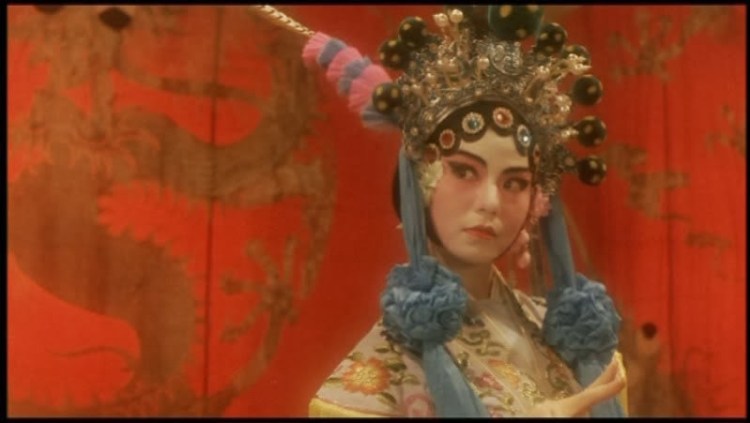
 It has been argued that Tsui Hark “epitomizes the lost promise of the New Wave,” as it relates to Hong Kong Cinema, but to imagine an Asian film market without his pragmatic and fervent compositions would leave an insatiable void. Brooding in excess, extremes, and Hollywood appropriations, Tsui almost single handedly transformed his nations New Wave cinema into a marketable product that would pave the way for westward expansion. His distinctive approach to the medium is manifest within continuing amalgamations of, not only cinematic conventions, but historical, cultural, and political representations as well. Peking Opera Blues (1986) typifies Tsui in its precise synthesis of genre, aesthetics, and thematic scopes that when melded together prove to be an eclectic piece of cinema. An auteurist approach coupled with pop sensibilities and aesthetics, results in a brand of curb appeal previously mastered by Hitchcock that segued to Tsui Hark and eventually wound up in the hands of Tarantino.
Stephen Teo reciprocates the idea of Tsui’s elemental synthesis stating that his body of work constitutes, “a cinema that integrates the aesthetics of avant-garde pop styles and the commercial instincts of genre cinema.” Though his claim should not be repudiated, it deserves to be expatiated. Integration of a Hark film does not end, nor begin, with simply combining abstract aesthetics with “instincts of genre.” Integration and amalgamated properties exist within each category themselves. From Drama, to musical, and comedy to action film, Peking Opera Blues spans over a minimum four genres, which not only works toward broadening the potential base of spectatorship, but when taken in consideration with the localization serves to extrapolate the irony inherent with Tsui’s expanding art. This style of quasi-sporadic genre weaving is a signifier of thematic juxtapositions and historical allegories waiting to be excavated from the films subtext.
Within the film’s narrative structure the opera theatre functions on many levels. Simply stated it is a relief, a place where identity can be hidden, and gender mistaken; inevitably it is a place for all worlds to collide. Bordwell remarks that, “Tsui treats the opera house as a crossroads of political and personal destinies,” which becomes more and more intertwined as the film progresses until finally it erupts in confrontation. The theatre is an arena where all social and economic classes collide in filmic metaphor. General Tsao represents Chinese imposition, Brigitte Lin and Sally Yeh’s characters are not only female heroines in a time when woman were never equated with power but also they are symbolic of the newer generation and revolutionary thinkers. These two in opposition are surrounded by crooked ticketing officers and a mass of common people who take absolutely no part in resolving conflict within the theatre- instead they uniformly fall to the ground, afraid to stand up for either side. These are clear-cut allegorical devices implemented by Tsui to construct a commentary on national history that can still resonate pertinent with Hong Kong today, and when combined with intricate choreography, vivid chromatic palates, and gender bending instances the film becomes a meticulous work seamlessly combining sociopolitical contexts and engaging visuals that can appeal to a mass market audience. It must be noted that the reversal of gender roles in Peking Opera Blues is a device employed to entertain and masquerade; not of a sexual political agenda but as Teo notes, “a kind of wicked metaphor for universality.” He goes on to substantiate this notion stating that, “the transmutation of gender is part of (his) quest for identity and nation inherent in the query ‘what is jianghu?’”
The finale of the film harkens back to the opening sequence of costumed theatre and painted face as a way to bookend the narrative. In regards to the epilogue Bordwell claims that, “any prospects of forming romantic couples dissolve into political turmoil. The sword-and-steed woman, now literally on horseback, must go separate ways.” Bordwell, however, fails to mention the ambiguity prevalent within the films resolution and its direct correlation with Tsui’s style. Though the conclusion does evoke unrest and notions of political turmoil it is contradicted by contentment; it then becomes a pristine example of the filmmaker’s penchant for amalgamations and business savvy meditation on the necessity that cinema become universal in its content and consumerist appeal alike. This ability to appease the senseless spectator and critic alike is precisely what epitomizes the distinctive diegetic realm of his films.
 Fourth Wall Writing