Elmore Leonard’s 1992 crime-fiction novel, Rum Punch, is instituted as a masterful framework for Quentin Tarantino’s film adaptation, appropriately re-titled Jackie Brown. However, an analytical view of the two works reveals many stark, contrasting elements that become analogous with and reveal the workings of a true film auteur. Though the screen version borrows heavily from Leonard’s work in terms of dialogue, characters, and plot, Tarantino’s narrative operates on a distinctly different level- transformed by the implementation of the director’s signature cinematic style. These characteristic elements are revealed through, as well with certain scenario omissions and filmic additions, three significant changes: in location, the shift of central focus/ the remaking of Jackie, and a distinguishing form of characterization, all of which are pieced together expectedly with a cinephilic incorporation of cinematic traditions and specific film genres.
The location shift from Miami to Los Angeles is an integral element cohesively linking all of Tarantino’s work up through the release of Jackie Brown. A setting teeming in Los Angeles subculture is arguably one of the most important aspects of the director’s work, affecting every aspect from dialogue and characterization to mise-en-scene and action. As the narrative shifts locales the characters are presented in a subtle yet completely differing light which is most noticeable through examining both Louis (Robert De Nero) and Melanie (Bridget Fonda). Leonard depicts Melanie as a woman with a “huge ass” and someone “who is thirty but looks much older.” Contrastingly, Fonda’s portrayal of the character is visually and dramatically indigenous to a beach of Southern California.
The image below, from a scene completely non-existent in Rum Punch, takes place as Melanie and Louis travel to “The world’s largest indoor shopping complex,” the Del Amo mall. Tarantino brings the viewer’s attention to the enormity and grandeur of the shopping complex and utilizes the events within and surrounding the complex to comment on the woes of the consumer culture of Los Angeles. His depiction is of a world ensnared in ignorant bliss and lost communication. Though Jackie (Pam Grier) is supposedly being watched at all times Nicolet (Michael Keaton) and the other officers fail to be present when it is most imperative and Louis gets lost trying to find his car. The shooting of Melanie is also an important observation in this same context as she is shot twice in the middle of an open parking lot during broad daylight but nobody manages to notice or seem to be capable of caring. In opposition Leonard’s novel specifically makes note of the security presence, stating, “One of those white Jimmy’s was coming up the next isle,” which implements a certain sense of urgency and consequence not apparent in Tarantino’s adaptation. Scenes in cars are rampant and distinctive throughout his films often revealing pertinent information in regards to characters (and their interactions), and time/ place. The choice to substitute Louis’ Toyota for a Volkswagen EuroVan works towards solidifying the film’s place in not only Los Angeles subculture but integrating characteristic elements of pop culture as well (with the choice of car and also his use of popular music in the scene- in this instance “Midnight Confessions” by The Grass Roots). This film is also littered with these characteristic car scene sequences which Edward Gallafent explains, “is a crucial mediation between interior and exterior in modern experience: the inside of a moving car, offering the chance to allow the outside world to pass at a distance, and sometimes to flee from the threat posed by it.” It is also worthwhile to think of theses two characters in the context of the whole film, which has them smoking an abundance of marijuana almost every time they appear together onscreen. This shift in location also proves to be useful in eliminating characters and unneeded plot extensions such as Renee and Da-veed as well as the encounter with the white supremacists.

The way Tarantino manages to reshape the players of the film elicits his cinematic style and distinctive authorship, which ultimately forms a clear divide between Jackie Brown and Rum Punch. An invaluable soundtrack lends itself to musical associations, which in turn adds depth to many of the characters and their relationships. The connection between Max and Jackie is altered drastically. Peter Travers expounds this notion stating, “The glory of the film resides in the unlikely romance between Jackie and Max. He hears music when he first sees her- it’s Seventies soul, of course. And she introduces him to the Delfonics (Woods p. 146).” Noticeably, the film is void of any extremely sexual interactions between the two. While they flirt back and forth, Tarantino manages to extract a much more personal and intricate examination of their attraction and intentions without any hint of a sexual encounter. The use and repetition of music, in particular The Delfonics, proves to be constitutive throughout the narrative and in character development. Max first hears the song “Didn’t I (Blow Your Mind This Time)” when Jackie plays it for him. From that point on the song becomes a metaphor for their relationship. The song presents allegorical lines like “Didn’t I blow your mind this time” and “Get this into your head, there’ll be no more” which is presented as a foreshadowing dialogue being given from Jackie to Max. This track in particular also provides an arena for Tarantino to parade his distinctive black comedic style that, along with his film “borrowing,” bends the genres of his films and allows for the crossing of spectator boundaries.
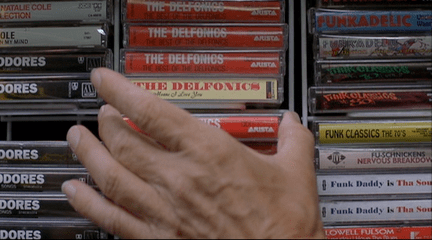
The image pictured above possesses many important elements that showcase a unique directorial style. The purchasing of the cassette tape works further in establishing Max’s character and developing his psyche, as well as the complex relationship formed between him and Grier’s character. His true feelings towards Jackie and his solemn, reserved love-struck demeanor is exposed to the spectator while providing the aforementioned comic relief. This also reoccurs on a more emphatic note towards the end of the film as Max and Ordell (Samuel L. Jackson) drive to the bail bond office Ordell pressing play and upon hearing the song, remarking, “I didn’t know you listened to The Delfonics,” with Max replying, “They’re pretty good.” Considering the context in which the comment is made, as well as the tension inherent in the climatic situation unraveling, it provides an extremely spontaneous and defining moment of comic relief.
The selection of cassette tapes is also one instance of many allusions and uses of black exploitation throughout the duration of the narrative. Tarantino remarks, “I brought a lot of the feeling of black exploitation films that I like to Jackie Brown. It’s like the debt Pulp Fiction owes to Spaghetti Westerns, Jackie Brown owes to black exploitation films. And the relationship that surf music had to Pulp Fiction, old school Seventies soul music has to Jackie Brown: that’s the rhythm and the pulse of the movie (Woods p.143).” Artists such as The Commodores, Delfonics, and “Funkadelic” compilations are an obvious reincarnation of the black exploitation films of the 70’s that Tarantino adores and remakes in a unique way with this film. Jackie Brown recycles music from Foxy Brown and Coffy, giving a more than obvious nod to Roy Ayers’ work on the soundtrack of the 1973 Jack Hill film Coffy and it is through the integration of these tracks and artists that the influence of black exploitation is most clearly defined and prevalent.
The most significant alteration in the film adaptation is its shift of focus and remaking of the main character Jackie Burke, a small white blonde, into Jackie Brown, a voluptuous African-American women. The most obvious example in this instance comes by way of the shift in title. Jackie Brown implores and forces the audience to shift their focus away from the other characters in the film and draw it to the actions and relations of Brown whereas the title Rum Punch refers to the codename given by Ordell to the money retrieval operation.
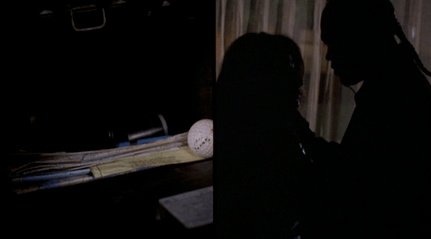
The third image, seen below, is a quintessential shot in dissecting issues of cinematic techniques, style, and nuances within the repetoire of the director. The shot propagates constant references, or infusion, to/ of film history and the “stealing,” which seemingly shadows all discussion of Tarantino as a filmmaker. He candidly remarks, “I steal from every single movie made, all right? I love it. If my work has anything it’s because I am taking this from this and that from that, piecing them together…great artists steal, they don’t do homages.” Some instances of this filmic “theft” are much more transparent than others and at times seem to go unnoticed, but the use of split-screen is one subtle element that should not be overlooked. As Jackie holds a gun to Ordell’s “bone” the elements of black exploitation are apparent but tethered together with a page out of Brian De Palma’s catalogue. In an overtly De Palma manner (whose reverting from constant cuts to the large scale use of split-screen in the 1976 film Carrie revolutionized the cinematic device and brought it to the forefront of the Hollywood film industry) the split screen use in Jackie Brown serves to intertwine elements of contrasting film genres to produce an entirely new experience. In a manner very characteristic of Sisters or Carrie, of which De Palma comments, “I felt the destruction had to be shown in split-screen, because how many times could you cut… You can overdo that. It’s a dead cinematic device (De Palma/ Knapp p. 42),” Tarantino employs the cinematic technique in a very reminiscent way that separates the world of film and literature with an exclusively cinematic element of storytelling, one quite impossible with the none visual nature of the novel. The two frames, it is worth to note, are also very characteristic of film noir with their use of dark shadows and dramatic subject matter- another genre which all of Tarantino’s work borrows from in one manner or another.
The pieces of story included in Rum Punch and omitted by Tarantino is another element of his extremely conscious directorial style that allows for his film adaptation to take on an entirely new context. In regards to his choices of inclusion he states, “I’m very much a believer that if you’re creating your own universe and your own mythology, you can have no question unanswered. But here’s the thing: I don’t have to answer the questions to you the audience. You just need to know I know the answer.”
In many ways the film adaptation of Leonard’s novel is strikingly similar but contextually they operate on completely different levels, only as a result of Tarantino’s characteristic and arguably unique cinematic style of filmmaking and story telling. Through his use of popular, or at the least, once popular music he is able to add a wealth of depth to his character, their on screen relationships, and the narrative in its entirety all while simultaneously infiltrating the cinema with a copious amount of pop culture and film history references. His “stealing” of genre and film traditions as well as his change in location to a much more personal space allows him to create a completely unique narrative from a very detailed adaptation. It becomes clear through the examination of these repetitive techniques and stylized choices that as an author and filmmaker Tarantino is nothing less than an extreme innovation and perhaps a revolutionary sort of post modernist art.
Works Cited
Leonard, Elmore. Rum Punch. New York: Dell, 1992
Woods, Paul A. Quentin Tarantino: The Film Geek Files. London: Plexus, 2005
Gallafent, Edward. Quentin Tarantino.
De Palma, Brian and Knapp, Laurence F. Brian De Palma: Interviews. University Press of Mississippi: 2003
 Fourth Wall Writing