Ruben Fleischer’s Zombieland appears not coincidentally in a time when America is plagued by a recessive economy and battling a seemingly insurmountable debt. The film is littered with verifiable allegories of a crumbling capitalist, consumer culture that aim to satirically awaken the spectator to the decaying vacuous nature of modern society. It manages to present a clever extension and elaboration of the zombie genre with a horror-com twist. While some of the “rules” to survival are clearly a meditation on prior genre customs there are also new interpretations of the patriarchal figure and a rehashing of what constitutes a core family unit. Zombieland is a film that relentlessly tears apart the free market destruction of our society and its values, but like most works that operate with a strong socio-political commentary the message must come under guise; in this case comedy and gore serve to devalue Fleischer’s critique enough to make it widely accessible and for it to potentially go unacknowledged by the average cinemagoer.
From the onset of the film the audience is presented with the defining subtext. The opening frame, depicting an upside down view of the American flag as it waves proudly in front of the Washington D.C. capital building, causes a jarring rumination that is expatiated with Columbus’ opening voice over. He states, “Oh America, I wish I could tell you that this was still America but I’ve come to realize that you can’t have a country without people, and there are no people here.” The camera pulls back and turns upright to reveal heaps of devastation and a zombie adorned in a business suit as he continues, “No my friends, this is now the United States of Zombieland.” The description that follows, detailing how Columbus manages to stay human, is extremely pertinent in consideration with the metaphorical content. Excessive consumption is first marked by the overweight and out of shape, or the “fatties” who are the first to go, and its also worthwhile to note that the infectious zombifying disease started with the ingestion of a contaminated hamburger*.
The evil and depravity of our social institutions are scrutinized by the mere survival of Einsenberg’s character. Survival of the fittest takes on a larger meaning within the narrative, as Columbus is able to sustain himself only because he has had the “advantage” of not ever having any real friends or close family. He is unexposed and ergo uninfected by society and its deteriorating concept of the family unit.
Tallahassee is a man who thrives on useful vengeance. The unrequited love he sustains for his lost son is illustrative of an acceptable family nucleus and his devout pursuit of the Twinkie is yet another allegorical device harkening back to a much simpler time in American history. With the Twinkie employed as a clever McGuffin for the motivation of his character we are reminded time and time again (to), “enjoy the little things.” With the reiteration of this ideal Zombieland becomes not necessarily a plagued place but rather a world of appreciative realizations. Tallahassee’s narcissistic decision to reproduce in such a society however is a major contradiction when considered in conjunction with the rest of the films themes and motifs but can be overlooked by virtue of its genuine nature. As they come to meet Wichita and Little Rock who run a scam on them, quite appropriately in a supermarket, they build a foundation for what eventually becomes a trusting and caring family, not bound by blood or circumstance, but by their own free choice- a choice only obtained as a direct result of society’s disintegration.
Reverting to localization for character names rather than using their given names is another plot device that extrapolates the reoccurring theme of societal structures diverting from the simplicity that made them pure and sustainable. In a post-apocalyptic world the survivors adopt their birthplace as an identifying characteristic just as earlier and more primitive civilizations; without exorbitant overpopulation it becomes unnecessary for them to use multiple or “distinctive” names. Wichita and Little Rock are intrinsically linked to the gender defining conventions of the genre. Their delusionary tactics are forged and melded within stereotypical female genre conventions; wedding rings and misplaced affection are ways for them to manipulate the opposite sex for monetary gain. This is not only an implication of the female but moreover it is a symbolic critique relating to the institution of marriage and its lacking legitimacy. In considering the mistrust associated with them it is also necessary to contemplate the role, however minimal, of Columbus’ roommate 406. When the first intimate contact he has with a female leads to almost being eaten alive it becomes hard for the viewer to sustain oblivious gazing without realizing the implications.
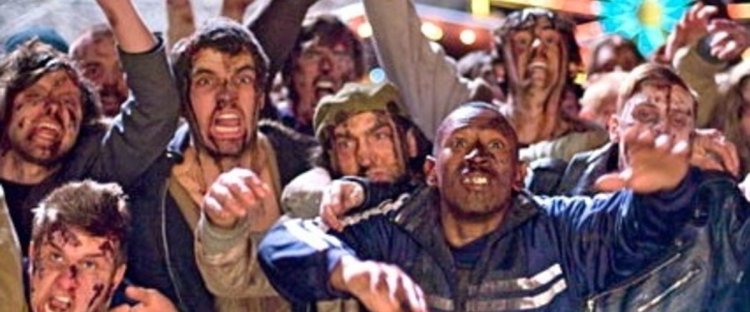
Many other aspects of the film serve to divulge the underlying thematic concepts; infected rushing towards the bright light of a deserted amusement park, survivors completely demolishing a retail store, and even the title of the film all stand as allegorical inferences to be made by the viewer. As with Romero’s Night of the Living Dead (1968) Zombieland operates on a purely allegorical level. Steven Shaviro states in Contagious Allegories that, “The ‘living dead’ emerge out of the deathly distance of allegory; their fictive presence allows Romero to anatomize and criticize American society, not by portraying it naturalistically, but by evacuating and eviscerating it. Allegory is then not just a mode of depiction, but an active means of subversive transformation.” He goes on to state that, “They do not mirror or represent social forces; they are directly animated and possessed, even in their allegorical distance from beyond the grave, by such forces,” substantiating the claim that it is not the zombie or the infected terrorizing the innocent but the social spirit embedded within them.
Though greatly comedic, Zombieland has an undercurrent of terrifyingly real social commentary for the spectator to absorb and contemplate. While utilizing conventions established by past zombie films it also manages to breathe life into the genre with a self-reflexive re-envisioning; It is a foreboding cinematic work that manages to work quite well under a clever satirical veil.
* Note: the two main protagonists are vegetarian (Einsenberg) and vegan (Harrelson) in real life.
 Fourth Wall Writing