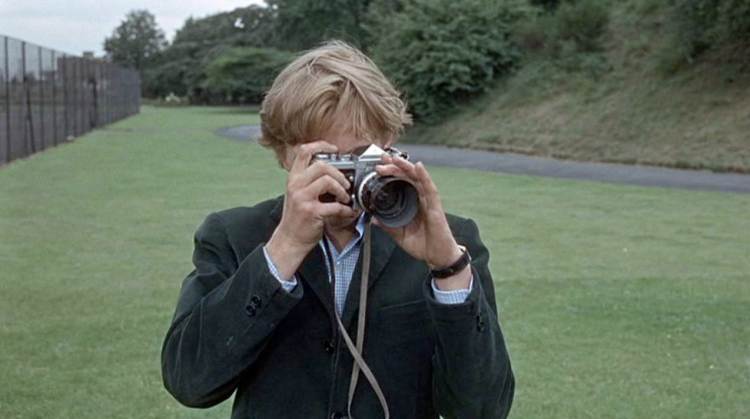
Michelangelo Antonioni’s first English language film Blow-Up (1966) is a definitive piece of work that pushed the boundaries of cinematic sexuality and diverged significantly from conventions of the classical Hollywood narrative. Thomas (David Hemmings) wanders through his day as a prestigious London Fashion photographer until he stumbles upon and accidentally photographs what he comes to think was a murder- a plot that would surely be indicative of a classic murder-mystery, detective case, or suspense/ thriller. Antonioni instead departs from expectations to form a brilliantly existential and reflexive story. Sound, character motivation, causal agents, and narrative closure are altered from antiquated conventions of classical Hollywood cinema, and in some cases, completely removed.
Howard Hawks’ screwball comedy His Girl Friday (1940) presents the spectator with characters and clearly demonstrates what steps they take to achieve a desired object or state of affairs; every character’s goal-orientation is clear and necessitated by the narrative. Walter conspires to have Hildy’s fiancée Bruce arrested on two separate occasions in an effort to keep her from leaving, he persuades Hildy to take on “one last story,” and goes as far as kidnapping her mother-in-law to be. All of Walter’s actions and general demeanor throughout the narrative lead directly to his definitive goal- reuniting with Hildy. Hawks establishes the goals and actions of each character to construct orientation characteristic of his work and the conventions of screwball comedy as well. Antonioni does no such thing. From the moment Thomas exits the doss house and jumps in his Rolls Royce his motivation and goal-orientation becomes conflicted and is only perpetuated as the film progresses. Unlike Walter Burns, Thomas takes no steps toward achieving any certain object or state of affairs. His treatment of Veruschka, abandonment of models and production staff, sexual exploitation of teenage girls, and clear lack of sympathy for the homeless he photographs amounts to complete ambivalence toward his profession. Even after he has apparently ratified his speculation of murder with a physical discovery of the dead body Thomas still takes almost no action in achieving any thing. He does not contact the authorities or investigate further but rather attends a drug heavy party in a failed attempt to have his agent confirm his discovery. One other scene that readily demonstrates Antonioni’s dismissal of goal-orientation transpires in the nightclub scene featuring The Yardbirds. Thomas enters the concert with no purpose and fights for a piece of Jeff Beck’s broken guitar only to carelessly toss it to the ground remaining unenthused and disinterested. Discarding of the shattered guitar and subsequent journey to a drug house marks the last failed efforts of the protagonist to acquire meaning in life. In an existential exploration that has no need for goals art (photography, Bill’s painting, mimes), sex (Veruschka’s photo shoot, the two teenage girls, walking in on his ex-girlfriend making love), and travel (unmotivated and contemplative trip to the antique store, the purchase of the wooden propeller) are resigned to becoming little more than temporary distractions.
Turning again to His Girl Friday as a pinnacle example of a film created within the classical style illustrates the importance of clear and complete character motivation. Often expounded by appointments and deadlines, the “motivation of agents” are the events and beliefs that drive a film’s characters into decisive action. Hildy eventually takes on her “final story” for The Morning Post because of Earl Williams’ impending execution and Walter’s actions are motivated by the fact that he must reclaim Hildy, or at least keep her distracted, before the train to Albany arrives. Blow-Up’s utter disregard for classical narrative structure manifests itself in its disparity to HGF and comparatively the lack of straightforward character motivation. Thomas ultimately has no motivating cause to preempt any of his actions. He arrives at the antique shop, nightclub, Bill’s flat, and almost every space he occupies with absolutely no purpose conveyed to the viewer. Thomas and concurrently the spectators are wandering around in aimless malcontent, wafting through a day of unrealized suspense. It would be easy but wrong to misconstrue his arrival at both fashion shoots as motivated by monetary or sexual gain. Antonioni never once implements a need for money into his narrative and Hemmings’ portrayal of Thomas is equally dismissive. His arrival at the house with Veruschka and his agent appear to be motivated by the discovery of the body but this is negated by his lack of real effort to contact or convince someone of his story, and remaining there for the entire night extrapolates Thomas’ unmotivated indifference.
Plots of classical narratives have a predilection for omitting chunks of time to only show events of casual importance. The removal of time spent sleeping, traveling, eating- and any other instance that is not of direct importance for the spectator piecing the story together- is compulsory for economic and conventional reasons. On-screen time is traditionally for the sole purpose of introducing key moments and information that will meld together to form a discernable story- mirrored by Thomas’ blowing up of the film prints and assemblage of a story that may be purely fabricated. Michael Mann’s Collateral (2004) institutes a framework reminiscent of Blow-Up in that its plot is the summation of a single day’s events. Collateral’s narrative configuration however adheres to a standard subordination of time whereas Antonioni’s film deviates from customary style. Mann’s film presents moments that are necessary for character development and advancement of the narrative arc. Every scene prior to the arrival of Vincent (Tom Cruise) is an essential establishment of Max Durocher’s (Jamie Foxx) character. His Spanish conversation with gas station attendants alludes to his intelligence and adaptability, the introspective staring of the tropical postcard represents a coping method or escape, and his argument with Annie Farrell (Jada Pinkett Smith) to save her money on the cab ride proves his selflessness and genuine character. Each scene after Vincent’s arrival still pushes character development but the on-screen occurrences are limited to those that are indispensable for the plot (we only see detective Fanning in instances of revelation or insight that may affect the fate of the narrative). In some ways Blow-Up does incorporate subordination of time but in a manner drastically variant from Hollywood cinema. The filmmaker refrains from meaningless shots of our protagonist going from point A to point B but there undeniably events that have little to no causal importance. Thomas’ trips to the antique shop and purchase of the propeller are in no way significant to the murder/ mystery/ detective plot the film is billed with, rather they constitute philosophical ponderings of the filmmaker- nothing more. The Yarbirds sequence is equally as insignificant to the plotline, representative of fleeting distraction and an element of the subtextual cinematic metacommentary.
Though there are certainly exceptions to every rule most films that adhere to classical Hollywood archetypes have clear and resolute endings with few, if any, loose ends unresolved- Blow-Up represents the antithesis to this convention. The lack of narrative closure may in fact be the most clear and resolute demarcation from classical cinema. Danny Boyle’s 2008 film Slumdog Millionaire is testament to the resiliency of narrative codes and their penchant for narrative closure. The flashback tale of Jamal Malik (Dev Patel) is one of unbelievable odds. Every event in his life leads up to one moment of romantic bliss and a fairytale ending that should be realized as entirely contrived. Basic formulas are at play to construct the most conventional type of cinema possible that ultimately ends with the euphoric and safe reunion of Malik and Latika (Freida Pinto). Slumdog could not possibly conclude with tragedy or ambivalence because that is not what is warranted by its classical sentiment and structure. Blow-Up disregards that filmic temperament entirely with its resolution- or rather lack thereof. Thomas not only lacks a definitive conclusion about what really happened in the park, he is absent any true meaning of life. The mimed tennis match is a final statement about questioning our perceptions of reality and the cinematic image. Hearing the sounds of a ball and racket but neither being visible requires more imagination of the viewer and inhibits contemplation of issues more substantial than narrative cohesion and resolution.
One point of stylistic departure- though there are many- is the sound design. Instead of relying on added non-diegetic accompaniment like Bernard Hermann’s score for Hitchcock’s North by Northwest (1959). Relying heavily on jazz Blow-Up confines musical compositions within the diegesis. There is also a very minimal amount of dialogue. Many Hollywood films rely heavily on information to be conveyed verbally but Blow-Up subsides from this idea, communicating almost every important detail visually.
Blow-Up is in many ways about the inability to communicate and its lack of adherence to Hollywood tradition is in direct correlation. Existential and overtly reflexive, the film requires much more from the spectator’s imagination than traditional cinema. Antonioni poses questions and presents scenarios with no answers or resolve, but a plot debilitated by distraction and ambiguity. Blow-Up stands as a landmark cinematic achievement; it’s surprise success uninhibited by standards of formulation and representation. The portrait painted of an iconic mod London in the midst of the 1960 swing and the sexual boundaries it pushed retain great historical importance, but it is the divergence from the formula/ style of classical Hollywood narrative that is paramount in considering the cinematic and cultural implications of the film.
 Fourth Wall Writing