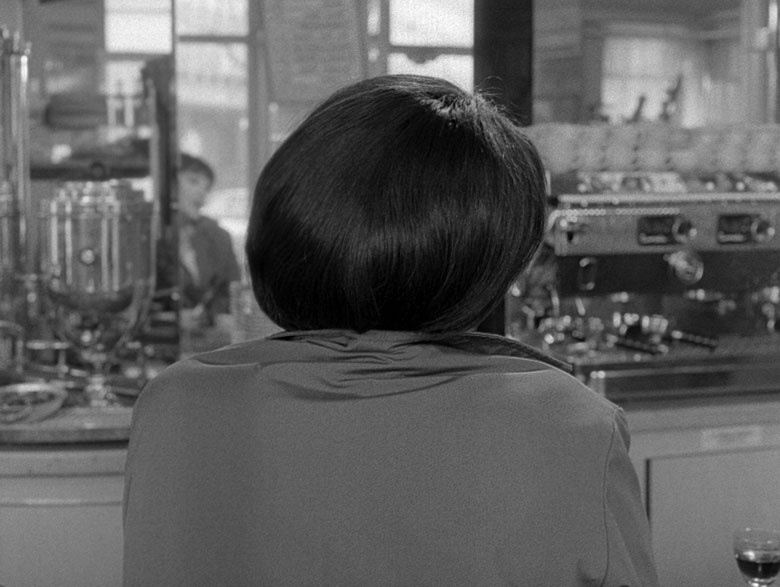
Following D.W. Griffith’s 1915 groundbreaking feature Birth of a Nation world cinema, in large part, became confined to certain conventions, seeming to skew itself into mindless entertainment. During World War II the industry had been misshapen by an infectious formula littered with political propaganda and fantasized realities. The years preceding the end of the war left a void to be filled: a yearning for a revitalizing and introspective look at the world of filmmaking, which was to ultimately be filled via the French New-Wave movement. Jean-Luc Godard’s third feature, Vivre sa vie (1962), stands arguably as the single best example of non-conventional, socio-political filmmaking from the countless threads of New-Wave artists and their respective work. Within his spontaneous and overtly Brechtian style of filmmaking Godard brings the spectator into a metaphysical realm illustrative of 1962 France. He finds a way of relaying a message via image composition and philosophical conversation as opposed to conventional narrative forms. Through a close analysis of the twelfth and final tableaux in Vivre sa vie it becomes apparent within such filmic devices as his choices in framing, mise-en-scene, camera movement, dialogue, and audio tracks that the content of the film is not only a meditation of de Gaulle’s social construct in France but concurrently film history and the language of a people as a whole.
The intrinsic value of Godard’s filmmaking lies not within its social commentary but rather his constant augmentation of form. As Colin MacCabe states, “Throughout Godard’s early films the search for a form of politics is also the search for a form of cinema which he could discuss politics.” (1) Thus it would only seem appropriate to first address the inter-title sequences, which preempt each segment of the film, and the significance of their usage. Each is presented through a fade to black separation intertwined with text indicating to the viewer what is to subsequently follow those tableaux. As Steve Cannon points out, “Godard was seeking to create a space between the images, a resting point, a point of reflection which is where this technique meets up with its Brechtian roots (2).” The twelfth tableaux, entitled THE YOUNG MAN. “THE OVAL PORTRAIT.” RAOUL TRADES NANA, tends to be one of the more ambiguous separations of these episodes as it does not itself foretell the inevitable fate of Nana, but any sort of critical thought applied to the tableaux and the context of this film as a whole will reveal the foreboding demise of Nana much before we get to see it happen. Taking into consideration the continuous downward trend of Nana’s well being and the fact that Godard relays to the audience that the film will be presented in twelve parts before it even begins is the first indication of where this final segment will draw its conclusion. Even more pronounced are the undeniable foreshadows to this event woven within the diagetic sound, his references to earlier cinema, and the characteristically undisciplined dialogue of the ‘players’ in the film. Douglas Morrey touches on all these bases:
There may be no title actually announcing Nana’s death at the end of the film, but commentators have suggested that this death is foreseen in the earlier gunshots, in Nana’s identification with Joan of Arc, in her earlier comment ‘I’ve had enough, I want to die’, in the account she hears of Porthos’s death, or in the quotation from Poe’s ‘Oval Portrait’ (3).
This infusion of Brechtian and Bressonian style filmmaking through narrative separation is acts as a jumping off point into the unique world of “documentary fiction” presented in Vivre sa vie.
Enter ‘The Oval Portrait,’ a story of an artists neglect of his wife in favor of her painted portrait, and Godard’s self referential ‘admission of guilt.’ The scene opens without the typical fade from black and cuts straight to the young man reading the complete collection of Poe as Michel Legrand’s lamenting score continues to run through. The man and Nana exchange words but the audience gets them via subtitles which becomes especially significant when we finally do hear a man’s voice and finally find that ever present fade to black. It brings yet another self-reflexive divide into the film, though this one carries much more weight to it. The voiceover reading of Poe is extremely significant in that the story itself represents the obsessive and destructive nature of capitalism, albeit in a roundabout way, while simultaneously expressing a prudent admission of guilt on behalf of Godard to his wife Anna Korina (Nana), and the audience conjointly. Morrey reiterates stating, “Godard appears to blame himself for neglecting his wife in the pursuit of his art, for caring more about Korina’s role in his films than in his life (4).” This act of admission gives a glimpse of a hypocritical Godard who is constantly, though often through subtle uses of Hitchcockian ambiguity, criticizing de Gaulle’s 5th Republic and the capitalist, consumerist nature that Europe has adopted after the war. He is also mindfully critical of the changing role of woman in society at this time. In this instance however we obtain a likening of Godard to ‘Nana’s pimps and clients through’ through the director himself, as they all ‘use her body for their own ends.’ Colin MacCabe makes good note of the socio-political nature of how Godard represents a woman’s sexuality:
As observer of woman as image and analyzer of the molding, masking process evolved by consumer capitalism, Godard is acute and rigorous. His consciousness of image as cultural product, consciousness of himself as part of and torn by cultural traditions, gives him an awareness of the levels of meaning that the image of woman has acquired in history like the grime on an ancient monument (5).
Because he chooses to make a profitable living with this style of filmmaking he has become somewhat a slave to the capitalist dogma, which he spends most of his time pontificating about throughout the rest of his work. It is a rare occasion where the director is brought down to the level of the audience and criticized. The first part of this tableaux is overall the most overtly self reflexive and Brechtian of any in the film as Godard addresses his known relationship with his actress directly through the words of Poe stating, “It’s our story, a painter portraying his love! Shall I go on?” The story is an affirmation that if one becomes too involved with the artificial they are bound to neglect the real beauty of human life and relations. The scene fades away from Karina’s Joan of Arc inspired Nana, framed in a stunningly close manner to the description uttered by Godard in his recitation of “The Oval Portrait,” and comes back into the narrative realm of the film once again marked with subtitled conversation and Legrand’s inspiring accompaniment.
The next scene beings with Raoul roughly shoving Nana across the pavement “criticizing her for not accepting ‘anyone who pays’ as a client. ‘Sometimes it’s degrading,’ she protests, still clinging to her elusive dignity (6), yet again another jab at the materialist and monetary obsession that seems easily to engulf the human mind and soul. The ‘elusive dignity’ that Sterrit recalls is comprehensive to all who operate within that type of social construct who are lead to believe, or foolishly believe that they are free to make their own decisions. As Nana enters the car with all of the pimps and hoods we are reminded of that fact that her “feminine mask is the passport to visibility in a male-dominated world (7), in this context meaning that her sexuality, along with all the other prostitutes, models, actresses, and so on are all degrading keys to power for the dominating male society. Next we get the final real documentary-like sequence of the film, as there are sprawling shots of 1962 France from what is assumedly the car they had entered in the previous scene. Conversation continues while the audience revels in what becomes a visual and aural document of history. A pinnacle moment while driving to the site of Nana’s exchange comes when their car passes a cinema playing Francois Truffaut’s classic of the same year, Jules and Jim. This moment realized within the context of the film is Godard wryly-critiquing Truffaut’s New-Wave leadership, essentially labeling him as a self-indulgent consumerist for his narrative filmmaking. Morrey draws attention to this important fact:
This is more than a light-hearted dig at Truffaut. The line has the authentic ring of Godard’s films of the late 1960s and early 1970s in which he angrily dismantled the empty promises that the leisure economy makes to the working classes (8).
Morrey, however, takes one small aspect of this remark too lightly in that he does not properly consider the source: A hood, a criminal, and pimp. Because it is derived from such a person it must be questioned why Godard would allot such insight to this type of character. It is most certainly a commentary centered on the ignorance of those in political power, those with the ability to change the social status of the people too impoverished to go to the cinema. The pimp is presented as a product of his environment allowing him to correctly assess the situation in such a matter-of-fact way. Though he is a criminal he understands the destructive nature of the societal confine established by the 5th Republic. After fully taking in the nature of that brief commentary it leads to a simple conclusion; if all of the characters in that car had more money they would not be situated in a position to commit murder nor become a victim of it. One small comment seemingly encapsulates Godard’s Marxist belief. The entire drive through these thriving streets of Paris gives us no glimpse of anyone in the vehicle. They are in constant conflict with this other world and only once visualized as they enter a much more quiet, baron landscape. Here is the metaphysical presented through mise-en-scene and the switching of scenery as the spectator is forced to draw conclusions of the ‘inward’ while only being given the view of the ‘outside’. This is by no means the best example of the metaphysical nature of this film, or perhaps even the tableaux, but it is a unique one that should be considered in conjunction with Godard’s break from cinema conventions, summed up with another statement made by MacCabe:
What was necessary was the disruption of the traditional organization of Hollywood cinema so as to investigate how images found their meaning within specific articulations determined by ideological and political struggles and to engage the film viewer in that investigation (9).
As the setting becomes dreary there are iron gates with the name “Hell & Sons,” the last foreshadow he offers to Nana’s fate. The vehicle finally rounds a corner and comes to a stop in front of another location labeled ‘Restaurant des Studios.’ Most certainly a reflection on how popular cinema is nothing more than an idealized fantasy and subjection of woman, quite unlike the documentary style cinema verite of Vivre sa vie. It is also interesting to note that this twelfth and final section is not only a reflexive commentary on, but also a foretelling of how Godard and Korina’s relationship will eventually play out. The final instance emblematic of the capitalist system and comes with the shooting of Nana. Human life and wellbeing literally takes a back seat to Raoul’s monetary mindset. As she curls up and dies all alone on the pavement “Godard’s camera makes a final abrupt gesture, moving sharply downward so the cold, empty streets fill the lower portion of the screen (10).” The scenes brings back the ever-present mindful decision of Godard to remake Nana in the image of Dreyer’s Joan of Arc, leaving “A faint materialist echo of the heavenward journey that Joan of arc might have expected (11).” Though nana may have shared Joan’s tears, haircut, profession, and fate Godard’s camera movement opposite that of Dreyer’s are clearly less liberating and hopeful. Nana, like all of the working class players of a capitalist system, has as Brice Parain stated, ‘passed through error’ but not arrived at any truth. Subsequently their fate is tragically intertwined with that of Korina’s enticingly grim demise.
Within this short instance all of the devices that have been utilized throughout the film come into play. Godard’s constant references to film history, Lengrad’s ambiguous score, substantial use of literary and philosophical devices, breaking of narrative conventions, and the self referential Brechtian style cinema all amount to define Godard as the auteur; a philosopher of film who presents an outward appearance to lead the spectator into the questioning the inward motivations of its characters and inevitably themselves. The cinema verite or “documentary fiction” of Vivre sa vie puts us inside a distinctive historical era which, by way of a metaphysical approach, demands the audience to speculate and ponder the meaning behind every scene in the film and the techniques employed by the filmmaker within the context of 1962 France.
Works Cited
(1) C. MacCabe, Godard: Images, Sounds, Politics (London: BFI/MacMillan, 1980)
(2) S. Cannon, ‘Not a mere question of form’: the hybrid realism of Godard’s ‘Vivre sa vie,’ French Cultural Studies vol. vii (1996) pp283-294, 284-85
(3) D. Morrey, Jean-Luc Godard (Manchester University Press, 2005), 42
(4) D. Morrey, Jean-Luc Godard (Manchester University Press, 2005), 44
(5) C. MacCabe, Godard: Images, Sounds, Politics (London: BFI/MacMillan, 1980), 91-92
(6) D. Sterrit, The Films of Jean-Luc Godard: Seeing the Invisible (Cambridge University Press 1999), 86
(7) C. MacCabe, Godard: Images, Sounds, Politics (London: BFI/MacMillan, 1980), 91
(8) D. Morrey, Jean-Luc Godard (Manchester University Press, 2005), 45
(9) C. MacCabe, Godard: Images, Sounds, Politics (London: BFI/MacMillan, 1980), 61
(10) D. Sterrit, The Films of Jean-Luc Godard: Seeing the Invisible (Cambridge University Press 1999), 87
(11) D. Sterrit, The Films of Jean-Luc Godard: Seeing the Invisible (Cambridge University Press 1999), 87-88
 Fourth Wall Writing