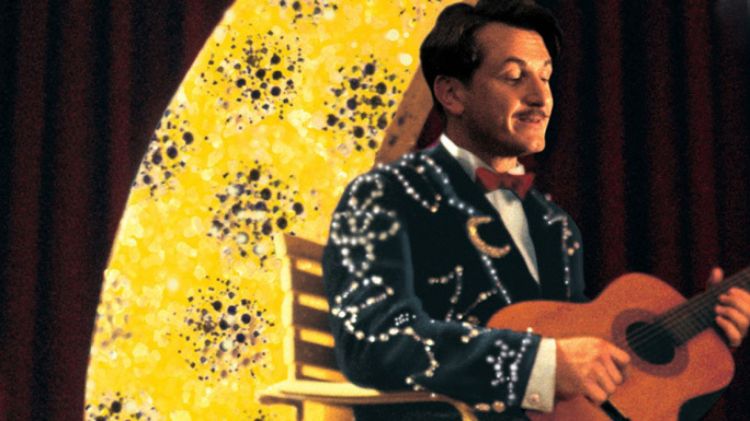
The perplexing art/ life dichotomy manifested in the work of Woody Allen is continually revisited with complex and often paradoxical results. Sweet and Lowdown (1999) is certainly no exception. The film’s narrative/ documentary hybridization focuses on little-known jazz guitarist Emmet Ray (Sean Penn) and his relationships with two different women- Hattie and Blanche. These characters represent a clever cinematic guise employed to explore ideas and ponderings of the filmmaker. Emmet, Hattie, and Blanche are allegorical figures used in narrative form to pose questions about the importance and interrelation of life/ art for the spectator, and perhaps Allen himself. In Sweet and Lowdown the main characters’ relationships expose the artist’s destructive tendencies and represent the detrimental potential art has to replace life itself.
Sweet and Lowdown floats in and out of life with introspective jazz breakdowns littered throughout the film. The ability of Emmet’s guitar stylings to enhance life, or provide temporary escape, is symbolic of what the filmmaker understands as art’s appropriation. At this point in his career Allen has developed a perspective that endorses the melding of art and life, understanding that the two worlds must reconcile for either to be sustained. Hattie and Blanche both understand this, albeit in completely different modes, while Emmet’s realization comes tragically belated. He cries out, “I made a mistake! I made a mistake!” His emotions and existence become relegated to those few records that he, like Django had always done, put his feelings/ life experience into.
Intimate and sexual moments in the film are replaced by Emmet’s guitar playing, the ultimate symbol for the predominance of art over reality and love in his life. Emmet’s first date with Hattie ends in his room where the guitar is already positioned dominantly on the bed. As the scene progresses, the most intimate and sentimental moment occurs after the inferred love making when Emmet plays guitar for Hattie. She stands euphorically frozen in the bathroom doorway, entranced by Emmet’s art and only legitimate form of expression; her orgasmic sensation comes not from Emmet’s sexual prowess but his art. The camera slowly dollys in to isolate her in the frame, it’s proclivity towards Hattie is the filmmaker designating life, no matter how dumb or mute, as the better choice, leaving Emmet to caress his guitar in a way that would better suit a woman capable of reciprocating love and affection. Allen corroborates this stance with Harland and Peters stating, “Films are not my top priority. I want to have dinner with my friends at a restaurant, I want to have a leisurely lunch and not rush through it… I always considered myself a very nice, sweet person, and not an artist. Not a dedicated artist at all.” If this is to be taken as truth, Emmet is a far removal from Allen as a person, and consequently Bailey’s audience/ artist interpretation of Sweet and Lowdown loses some of its legitimacy.
The proceeding scene portrays Hattie as juvenile and in awe of the protagonist’s artistry, a common motif for female counterparts in Allen’s oeuvre. Her sailor-like dress and trademark hat quietly evokes Annie’s wardrobe during her first conversation with Alvy after their doubles tennis match in Annie Hall. Hattie’s devouring of dessert- like Annie’s guileless conversation and reckless driving- are immature characteristics that ultimately become replaced to negative effect. Annie’s eventual maturity and garnered intellect lead to her dismissal of Alvy and his biggest connection to life- love. Blanche is the latter part of Annie that Emmet chooses for her beauty and intellect, this choice generating incredibly detrimental effects. Like Isaac’s decision to abandon sweetness and genuine affection (Tracy) for experience and sophistication (Mary), Emmet has made a mistaken from which there is no return. The film expounds this notion with Emmet’s attempts at dressing Hattie, his remarking to his manager, “She’s like a kid. She loves tearing the paper off the boxes,” and earlier to the drummer, “She’s a genuinely sweet person. I like that- I respect it, but it wont get you anywhere in life.” It is in fact Emmet who won’t get anywhere in life, but rather end up “crying in his beer” because he missed his opportunity to merge art and life. Emmet’s inability to alter Hattie or Blanche in any way is clearly representative of art’s incapacity to control life. Emmet- as an allegory for art- is greatly affected by both relationships, substantially more with Hattie who continues to persevere without art.
After a montage of Emmet and Hattie’s blossoming relationship comes the first and only scene in which Emmet reveals any significant personal information. The instance carries a lot of symbolic weight as it is not only about the lack of paternal love but about how close Hattie has come to Emmet’s art. She is now situated on the bed that the guitar originally was, now repositioned next to Emmet’s with the nightstand removed. But they are still two separate beds with a divide Emmet cannot bridge. His is a world of art and hers of life and love. Hattie’s desire and affection is conveyed with her position on the bed- as close to Emmet’s side as she can be. Hattie patiently waits to be allowed to move over, while Emmet stays in the center of his disconnected artistic realm. Emmet’s original departure from Hattie is a direct result of his art and further disconnect from life/ reality. Because he plays so well a woman, who persuades him to leave Hattie for the night, approaches Emmet. Further removing him from reality Emmet indulges in drugs and alcohol, which not only takes him away from his art (missing the gigs he was scheduled to play) but life (Hattie’s love) as well.
The gloves Hattie gives to Emmet for his birthday are a cinematic metaphor of her love, and subsequently life’s ability to preserve his art. Bailey insists that Hattie is “an embodiment of the audience,” which given her muteness is a fair summation but he fails to make the connection between the audience and reality- in fact the audience is reality, it is speechless love and admiration that, as the gloves denote, preserve art. To connect this birthday gift with an earlier instance reveals Hattie’s attempt to amalgamate Emmet’s art and life. On their way to Hollywood to film the “All of Me” short they are forced to break as a result of a flat tire. Emmet forces Hattie to do the labor while he and Shields relax in the grass saying, “you know I can’t risk my hands.” Her purchasing of the gloves for his birthday symbolizes an opportunity for his art and life to coexist. With the protection of the gloves afforded to him via Hattie, Emmet would no longer have to worry about risking his hands (art) to function in life. But nonetheless he abandons the opportunity, terrified by the prospect of love.
In his book The Reluctant Film Art of Woody Allen Peter J. Bailey remarks, “As for Harry Block, so for Emmet Ray: all weaknesses are redeemed- perhaps even validated- by the fact that he’s an artist.” He goes on to discuss the relationship Sweet and Lowdown shares with Deconstructing Harry stating that, “Allen revisits and reverses that resolution in Sweet and Lowdown, largely through allegorizing Emmet’s dedication to his art as the very attitude that alienates him from the audience which holds out his best hope for salvation. If Harry Block’s life is saved by his art, Emmet Ray’s seems to get sacrificed to his.” In Sweet and Lowdown Al Torrio replaces Larry’s role in Deconstructing Harry. Blanche remarks to Torrio, “With you its like I’m looking into the heart of darkness. Emmet is an artist… he seems to exist in a world of his own.” Her lines recant not only Larry as the devil, but Harry’s alter ego who attracts Faye Sexton and ultimately wins her heart. Faye’s character, like Annie Hall, is essentially Hattie and Blanche assembled as one. Instead of introducing one main love interest and demonstrating her evolution from naïve admiration to an independent realization of the protagonists flaws- and his disconnect from life- Sweet and Lowdown has presented them in two parts with Hattie and Blanche. Faye was never really in love with Harry just as Hattie never really loves Emmet. With not a single redeeming quality it is obviously only Emmet’s guitar playing Hattie is in love with, and Harry’s writing that Faye is attracted to. Bailey says, “Harry’s bitter acknowledgment that life won’t submit to his imagination the way that it does in his fiction constitutes significant growth,” and it is one the continues to evolve with Sweet and Lowdown. Harry Block seems positively resigned to be functioning properly only inside the world of art but Allen has expanded upon that notion with Emmet Ray, a character who wants to function only as an artist. Ignoring the opportunities and emotional sentiments of life leaves Emmet sobbing alone with the pieces of his guitar littering the ground. It is because of his refusal to reconcile the two worlds that Emmet’s art never propels him to stardom and concurrently his life falls apart into myth.
Allen’s oft revisited idea that, “the heart wants what it wants,” is played out in tragic fashion. Emmet clearly does love Hattie: his divulging of his parents fate, taking her to Hollywood, crying out for her in his sleep, a failed attempt at reunion and ultimate breakdown, are all in place for the spectator to recognize that Emmet knew what his heart wanted but decided to sacrifice it for his art. He had begun to accept life when he accepted Hattie, but his egocentric and convoluted ideas of artistry caused him to negate what his heart had wanted. Essentially, what Emmet fails to realize is that both he and his art cannot function without life and love. This is solidified by his breakdown, smashing of the guitar, and the fact that the only recordings of any real value were songs inspired by his heartache. Bailey substantiates this claim stating, “The lesson implicit in the success of ‘Unfaithful Woman’ (is) that art and life are related, that Ann was right in claiming that if he let his feelings out in real life, his music would be greater.”
Bailey is wrong, and in contradiction with himself, when he claims that, “Hattie’s terminal removal from his life does not in itself nullify Emmet’s chances of experiencing satisfying artistic achievements.” In fact it is the very night in which he learns of Hattie’s marriage and new life that he goes on a drunken bender and decimates his guitar. Allen and Pickman both make it clear that nobody knows what happened to Emmet Ray, and indeed that he “may have stopped playing altogether.” It would seem very unlikely that Emmet would be able to “experience satisfying artistic achievements” if he had abandoned his craft altogether. Satisfaction for a small group of jazz aficionados seems likely, but most certainly not for Emmet Ray himself. Even if in his last few recordings Emmet managed to surpass the greatness of Django, art has now replaced life. Emmet is resigned to disintegrate into folklore and jazz legend.
Emmet’s early conversation with Ann- while burning the moon- foreshadows the rest of the narrative progression. She says “You keep your feelings all locked up, and you can’t feel nothin’ for anybody else.” Ultimately this inability is what prevents him from becoming a star on par with Django Reinhardt and also what prevents him from accepting life. Instead, for Emmet, art replaces life. The only real thread of him lives on posthumously in his art. As Bailey says, “Emmet Ray vanishes into his recordings, his music usurping his life,” and noticeably these recordings come after his traumatic relationships where, “something just seemed to open up in him.” In Sweet and Lowdown Hattie’s character is an allegory for what Emmet needs. She is the love and life that can offer Emmet something more out of reality than just shooting rats at the dump or watching trains go by. Blanche is a sort of femme fatale who offers a compromise of art and life that cannot coagulate with Emmet’s unmitigated artistic desires. In fleeing from the one opportunity for reconciliation in Hattie, Emmet has figuratively died by the close of the film, only to be retained within a few rare recordings.
 Fourth Wall Writing