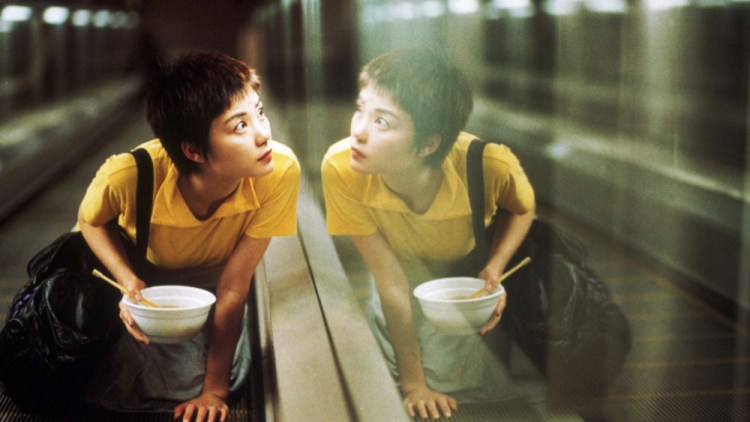
Every piece of art is grounded and conceived as a result of predating influence and inspiration- cinema is no exception. The Lumiere brothers were inspired by photography, by painting, and immensely through properties of their environmental surroundings. As film began to evolve from simply a new technology into an artistic facilitator, and eventually a superlative medium, the concept of the auteur emerged. Porter to Griffith, all the way to Tarantino and Lynch, these filmmakers are always and forever indebted to their predecessors, but manage to evolve to formulate a distinct style enriched with pre-existing elements of cinema. One of the most prolific stylistic syntheses of two filmmakers can be observed in Jean-luc Godard and the stylistic markings of his work within Wong Kar Wai’s Chungking Express (1994). Though both approaches and respective renditions utilize an eclectic mix of narratively discontinuous and reflexive bravado, the product of each director remains distinct. In comparing reoccurring themes, motifs, stylistic tendencies, and utilization of varying filmic devices in Vivre Sa Vie (1962) and Chungking Express reveals an ironical separation by way of assimilation emerges. After extrapolating difference from similarity Wong’s work materializes as predominantly personal while Godard is differentiated by his predilection for concentrating on the more overarching societal implications of the film and its self-reflexive nature.
Analyzing the relationship of the two filmmakers disseminates thematic elements from the formal, meaning Chungking engages the spectator with the same techniques as Godard (jump cuts, voiceover, references to literature, inclusion of pop culture, Brechtian proclivity, narrative/ temporal discontinuity) but the subtext derived indicates a stark contrast. While all shared techniques would purvey variance upon evaluation the prevalent use of voiceover, location, gender roles, and other self-reflexive characteristics provide the clearest distinction.
Voiceover is a device employed extensively by both directors, which exemplifies their diverging of motifs. Throughout Vivre Sa Vie off-screen dialogue is recited and utilized as a way of conveying sociopolitical ideals. Non-diegetic dialogue is relegated to the male perspective, and in one instance is Godard himself addressing the audience. Enter ‘The Oval Portrait,’ a story of an artists neglect of his wife in favor of her painted portrait, and Godard’s self referential ‘admission of guilt.’ The scene opens without the typical fade from black and cuts straight to the young man reading the complete collection of Poe as Michel Legrand’s lamenting score continues to run through. The man and Nana exchange words but the audience gets them via subtitles which becomes especially significant when we finally do hear a man’s voice and are signaled by that ever present fade to black. It brings yet another self-reflexive divide into the film, though this one carries much more weight to it. The voiceover reading of Poe is extremely significant in that the story itself represents the obsessive and destructive nature of capitalism, albeit in a roundabout way, while simultaneously expressing a prudent admission of guilt on behalf of Godard to his wife Anna Korina (Nana), and the audience conjointly. The only reflexive property of Wong’s voiceover stems from the simple fact that it is just that. In essence this situates Chungking as a more traditional narrative but moreover it isolates character and instigates spectator identification whereas Godard’s implementation expands the subjectivity and concurrently the social spectrum of the film. Chungking Express opens with Qiwu’s voiceover. From the onset his interior monologue establishes a report with the viewer as well as temporal discontinuity. At times he confronts the audience directly stating, “We all have our habits,” and “We all get our hearts broken.“ Interjecting development of character psychology and motivation with this type of direct address/ audience integration constitutes Wong’s penchant for personal rather than sociopolitical contemplation- of which he relegates to a much more subversive and ambiguous realm of the narrative than Godard. The eighth tableaux has Nana’s newfound pimp, Raoul, describing the social conventions and legal regulations of prostitution in 1962 Paris via voiceover while the screen is occupied with a montage of Nana becoming acclimated with her dismal profession.
Like Wong, Godard displaces time but in a much more overt and political manner. The segment is meant to equate practices of prostitution to capitalism and its detrimental effects on an aesthetically and monetarily obsessed culture. Considering the impetus for the film is Nana’s desire to become wealthy and famous, which subsequently leads to the loss of her family and ultimate demise, it would be ignorant to say that there is any theme more dominant than the destructive nature of capitalist institutions. Wong on the other hand is not only accepting of capitalism, but obviously concerned with Hong Kong’s possible hand over to communist China. Product placement and pop culture references are meticulously woven into Chungking Express as a way of crossing cultural barriers and expanding to a transnational platform. Consistent showcasing of Coca-Cola signs, Garfield’s appearance, the Indian smugglers, musical cues, and omission of specific location markers all work to facilitate spectator identification with each male character and their respective situation. Godard’s infusion of pop culture and music on the other hand is a distinct attempt to make the viewer aware that they are watching a film and to comment on the vacuous nature of mass produced consumer goods.
Gender roles in both Vivre Sa Vie and Chungking Express come to embody the conceptual difference of each filmmaker. Godard becomes mindfully critical of women’s role in society and takes the opportunity to present a heavy-handed commentary. In his book Godard: Images, Sounds, Politics Colin MacCabe states, “As observer of woman as image and analyzer of the molding, masking process evolved by consumer capitalism, Godard is acute and rigorous. His consciousness of image as cultural product, consciousness of himself as part of and torn by cultural traditions, gives him an awareness of the levels of meaning that the image of woman has acquired in history like the grime on an ancient monument (p. 91-92).” Because he chooses to make a profitable living with this style of filmmaking he has become somewhat a slave to the capitalist dogma, which he spends most of his time pontificating about throughout the rest of his work. It is a rare occasion where the director is brought down to the level of the audience and criticized. Godard addresses his known relationship with his actress directly through the words of Poe stating, “It’s our story, a painter portraying his love! Shall I go on?” The story is an affirmation that if one becomes too involved with the artificial they are bound to neglect the real beauty of human life and relations. The scene fades away from Karina’s Joan of Arc inspired Nana, framed in a stunningly close manner to the description uttered by Godard in his recitation of “The Oval Portrait,” and comes back into the narrative realm of the film once again marked with subtitled conversation and Legrand’s inspiring accompaniment.
Bridgitte Lin’s blonde-haired homage to Cassavetes’ Gloria is reminiscent of a financially obsessed female like that of Nana, the distinction is obvious with Faye Wong’s character. She is in no way fiscally restrained. She is elusive, mysterious, acutely observant (unlike badge #663), and charming; incongruous with Nana’s ignorance and superficiality. Going to great lengths to reinvigorate #663’s life and romantic inclination Faye is a testament to Wong Kar Wai’s hopefulness. Her character not only evens out the bitter end for Qiwu, she also represents one of the larger divergences between the directorial styles of both Wong and Godard. Nearing the end Vivre Sa Vie a scene beings with Raoul roughly shoving Nana across the pavement “criticizing her for not accepting ‘anyone who pays’ as a client. ‘Sometimes it’s degrading,’ she protests, still clinging to her “elusive dignity,” yet again another jab at the materialist and monetary obsession that seems easily to engulf the human mind and soul.
Wong’s “step-printing” or “smudge motion” approach simultaneously represents time displacement, character detachment, urbanity, and the painted veil of Hong Kong. Stripping the cities visual identity by turning neon signs into temporally augmented streaks adds ambiguity and also isolates characters, who are the true allegorical figures of the film. With this technique the viewer is forced not only to acknowledge the medium but also to identify with player’s thoughts and question their contemplations. As the spectator we are now concentrated on an individual rather than a space. Godard represents the spatiotemporal part of Vivre Sa Vie with Brechtian and Bressonian infused cinema verite. This type of “documentary fiction” is positively a device aimed at criticizing de Gaulle’s 5th Republic and the capitalist, consumerist nature that Europe has adopted after World War II. If Wong’s step-printing technique as metaphorically linked with the political realm surrounding Hong Kong it is contemplative and unsure at best, but a sort of optimism manages to remain with the closing of the film. Both films promote indigenization however Godard takes much more pleasure in showcasing his city with very distinctive monuments and locales when Wong displays Hong Kong in a very ambiguous manner, a stylistic choice undoubtedly representative of the city’s uncertain future.
A multifaceted incorporation of Godardian/ French New Wave techniques and devices make up Wong Kar Wai’s Chungking Express but with the comparison of each direcotor;s work one might arrive with incredibly different thematic results.
Works Cited
- C. MacCabe, Godard: Images, Sounds, Politics (London: BFI/MacMillan, 1980)
 Fourth Wall Writing